Ten Men Home
BEHIND THE SONG
HONOR COLLECTION
A song written so courage, faith, and ten names will never disappear into history.
Some lives are remembered in dates, citations, photographs, and museum records.
Walter Travis Stewart’s life deserves every one of those forms of remembrance.
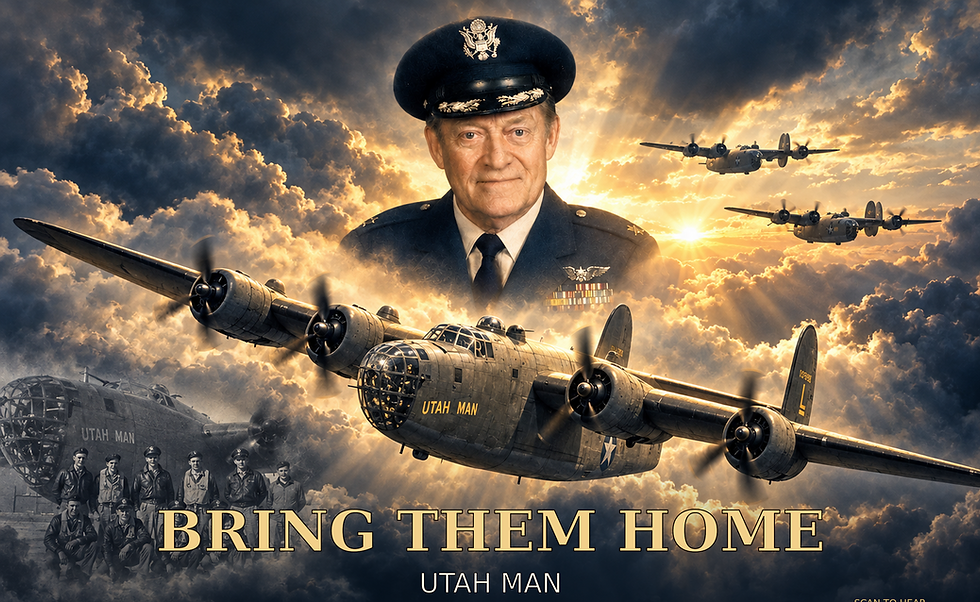
The archives preserve the facts: a farm boy from Benjamin, Utah, became a B-24 pilot; flew 32 combat missions and 236 combat hours; led surviving bombers through one of the most dangerous air raids of the Second World War; and brought his entire crew home in a plane torn open by enemy fire.
But a family does not remember only in facts.
A family remembers a voice.
That is why Ten Men Home (Utah Man) exists.
A Songimony™ honoring
Colonel Walter Travis Stewart (1917–2016)
The Mission
The mission that tested them all
On August 1, 1943, five groups of B-24 Liberators lifted from bases near Benghazi, Libya, for Operation Tidal Wave—a low-level attack on the oil refineries surrounding Ploiești, Romania. The plan demanded a round trip of roughly 2,400 miles, much of it without fighter escort. Bad weather broke apart formations. Navigation errors disrupted the approach. Radio silence made correction harder. By the time the bombers reached Romania, the carefully rehearsed plan had become confusion, smoke, gunfire, and individual acts of judgment.

The scale of the loss remains sobering. Of 178 B-24s launched, 54 were lost. Hundreds of airmen were killed, wounded, captured, interned, or reported missing. Modern Air Force histories remember the mission for extraordinary courage while also acknowledging its terrible cost and limited short-term strategic effect. That distinction matters. This is not a story about making war look glorious. It is a story about what people did for one another when the mission had gone wrong and there was no safe choice left.
Walter Stewart was already an experienced combat pilot. Operation Tidal Wave was his 31st mission, and his reputation earned him a position as deputy leader of the 93rd Bomb Group’s attacking formation. Ahead of him flew Lt. Col. Addison Baker and Maj. John Jerstad in Hell’s Wench. When their burning aircraft went down, Stewart assumed the lead and continued toward the target through intense antiaircraft fire.
His bomber carried a temporary name chosen for Utah pride: Utah Man.
The aircraft came home with 365 holes in it. Its fuel system was damaged. Its speed had to be reduced. Walter and his crew landed roughly two hours after most of the returning aircraft, after they had nearly been given up for lost. The remarkable fact at the center of the song is not simply that Walter Stewart survived. It is that all ten men aboard survived together.
Ten men flew out.
Ten men came home.
Ten men out.
Ten men home.
The lyrics take us from predawn Libya to the treetops over Ploiești, from the fall of Hell’s Wench to the damaged fuel tank, the long return over darkness, and the runway lights that finally appeared after fourteen hours. The chorus reduces that enormous story to a line a child can remember after one hearing:
“Ten men out. Ten men home.”
That line is intentionally larger than one pilot. Walter was the aircraft commander, but Utah Man did not come home through the work of one man. A B-24 was a crewed machine. Pilots, navigator, bombardier, engineer, radio operator, and gunners depended on one another. The song honors Walt best by honoring the trust placed in him—and the men whose courage made his leadership possible.
The sound of the memory
Even the arrangement serves the memory. In the chorus, the orchestra rises like four B-24 engines gathering power. Low strings, brass, drums, and harmonies create the sensation of a bomber formation without allowing the machinery to overpower the human voice. The engine sound becomes more than atmosphere. It becomes a recurring signal: danger, duty, endurance, and finally homecoming.
Why the song speaks in Walt’s voice
The song is written in the first person because distance can make history feel abstract. “A pilot flew a mission” belongs to a textbook. “I pushed all four engines forward” places the listener inside a decision.
Inside the Song

The Man Behind the Mission
Faith, humility, and the humor that made him human

Walter Stewart’s courage did not exist apart from his faith, and his faith should not be reduced to a claim that good people are guaranteed safety. The losses over Ploiești make any such claim impossible.
Instead, the song places faith where it belongs in Walt’s story: in the strength to serve the person beside you, remain steady when fear is justified, and do the next right thing without knowing the outcome. His faith appears in prayer before takeoff, gratitude after landing, and humility whenever attention turns toward him.
The archival record also preserves a man known for warmth and humor, not a marble figure standing permanently at attention. The song allows flashes of Walt’s dry wit to appear before the danger tightens: Texans named their aircraft, so naturally Utah would too; a reluctant bomb rack chose a poor time to “change its mind”; an empty fuel gauge became a problem too far from home to solve on foot.
The humor is carefully timed. It never intrudes upon the loss of Baker, Jerstad, or the airmen who did not return. Instead, it lets future listeners meet a person rather than only a decorated officer. Heroism becomes more believable when the hero is recognizably human.
“Heroism becomes more believable when the hero is recognizably human.”
Recognition
The honor that arrived fifty-two years later
Walter Stewart’s Distinguished Service Cross was not presented to him until 1995, fifty-two years after the raid, because of a wartime clerical error. By then, the medal belonged to history. Walt’s response belonged to character: he continued directing attention toward his crew and the men who had been lost.
That humility is essential to the song. It resists the easy version of heroism in which one man stands above everyone else. Walt’s reputation was built on steadiness, responsibility, and remembrance. The delayed medal confirms the nation’s recognition, but it does not create the honor. The honor was already present in the aircraft—in the choice to take the lead, the crew’s work under fire, and the determination to bring every man home.
The Hill Air Force Base historical record documents Stewart’s 32 missions and 236 combat hours. The University of Utah’s oral-history collection preserves hours of his own voice and a substantial transcript. Aircraft records and photographs held by the American Air Museum in Britain, the Imperial War Museums, and the U.S. National Archives preserve the machines, units, images, and documentary trail.
Together, those institutions protect the historical record. This song protects something adjacent to it: the emotional inheritance.
“The delayed medal confirms the nation’s recognition,
but it does not create the honor.”

Your Story
Who in your family deserves to be remembered this way?
Dates and records tell us what happened.
A Songimony helps preserve the voice, values, humor, courage, and story behind the name.
Some stories should not become only a photograph, a medal, or a line in a family tree.
They deserve to keep speaking.
Living Memory
When the eyewitnesses are gone
There comes a moment in every family when memory changes form.
The people who heard the story firsthand are no longer present to tell it. Photographs remain, but the voices around them grow quiet. Medals may be kept safely in a box. Names appear in a family tree. A child knows that a great-grandfather served in a war, but the distance between “he served” and “this is what he carried” can become enormous.
Music helps cross that distance.
A melody gives memory a path back. Rhythm organizes details the mind might otherwise lose. A chorus becomes language a family can carry without opening a file or reading a citation. Years from now, one of Walt’s great-grandchildren may not begin with a museum catalog or a mission report. They may begin by pressing play.
They will hear four engines rise.
They will hear the name Utah Man.
They will learn that their great-grandfather took the lead when the lead aircraft fell. They will learn that courage included fear, that faith included uncertainty, and that leadership meant responsibility for other lives. Most importantly, they will remember the outcome in words simple enough to keep:
“Ten men out. Ten men home. No man flies a war alone.”
That is the purpose of this Songimony
What Remains
The story does not end with the record
The archives will continue to tell future generations what Colonel Walter Travis Stewart did.
This song helps ensure they will remember why it mattered—and that they will know him as Walt.
This song helps ensure they will remember why it mattered—and that they will know him as Walt.
Archival foundation
This editorial draws upon records held by the National Museum of the United States Air Force, Hill Air Force Base, the University of Utah, the U.S. National Archives, Imperial War Museums, the American Air Museum in Britain, and the Gathering of Eagles Foundation. Where institutional accounts vary slightly in mission totals, the public narrative uses the most consistently supported figures and keeps the human story at the center.
Preserve Their Story
Some stories should never become only a name and a date.
Every family has stories that deserve more than a photograph, a record, or a name in a family tree.
A Songimony turns those memories into something that can be heard, shared, remembered, and carried forward.
Preserve the voice, values, humor, courage, and story of someone who matters to you.